"You’ve prepared harder than ever for an upcoming competition. You’ve trained, planned and practised everything you can. During the game, you make a few mistakes that you know you’re capable of avoiding. After the game, your coaches and teammates keep telling you how well you played. But instead of enjoying the performance, you find yourself fixated on the mistakes you made.".
Wanting to perform at your best is a normal part of sport. You set high standards, work hard and care about improving. But when does this become perfectionism?
Perfectionism involves pursuing extremely high standards while being overly critical of yourself when those standards aren't met. In sport, this means perfectionism is often less about how well you perform and more about how you think and feel about yourself when you don't perform as expected.
The problem is that perfectionistic standards can become so demanding that they are impossible to meet consistently. Every athlete will make mistakes, have poor performances and experience setbacks. For someone experiencing perfectionism, however, falling short can be interpreted as "I didn't work hard enough" or "I'm not good enough" rather than "That didn't go to plan, so what can I learn from it?"
Sport psychology research commonly distinguishes between perfectionistic strivings and perfectionistic concerns.
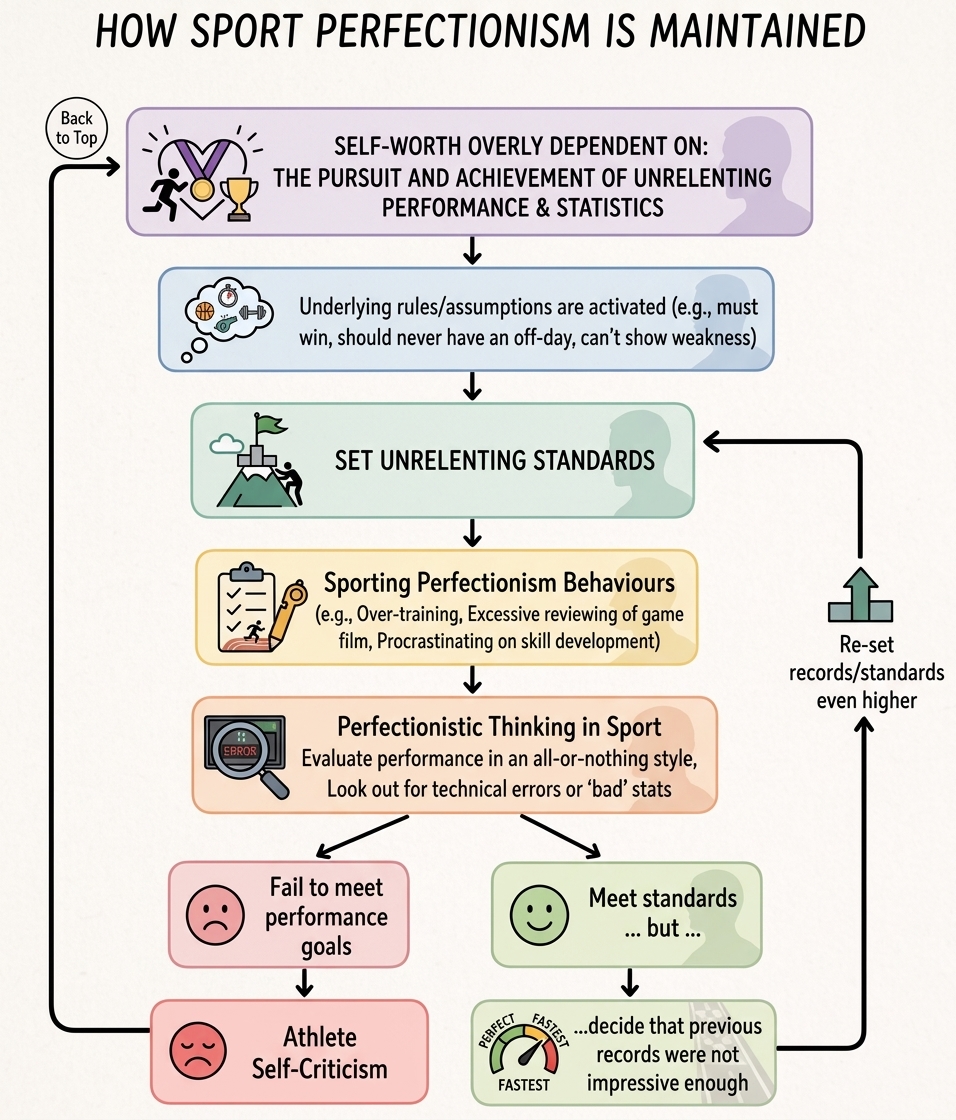
Perfectionism can create a cycle where nothing ever feels quite good enough. Even after a successful performance, an athlete might dismiss it as a fluke, focus on what could have been better or immediately set an even higher standard.
It can also show up through behaviours such as procrastinating, excessive preparation, repeatedly checking or correcting things, seeking reassurance, struggling to make decisions, constantly training or finding it difficult to know when to stop.
These behaviours aren't always problematic on their own. Preparation, organisation and hard work can be valuable. The question is whether they are helping performance or being driven by a fear of making mistakes.
Research consistently links perfectionistic concerns with greater competitive anxiety, fear of failure, negative reactions to mistakes and athlete burnout. They have also been associated with depressive symptoms and unhealthy exercise or eating behaviours.
By contrast, perfectionistic strivings can sometimes be associated with better performance, particularly when concerns about mistakes are lower. This is why the goal isn't to eliminate high standards, it's to prevent those standards from becoming a source of constant threat and self-criticism.
It's easy to understand why perfectionism develops. High standards, hard work and wanting to do things well can all be strengths. The challenge is staying on the diligent side of the line rather than reaching a point where nothing feels good enough.

Psychological work focuses on changing the thoughts and behaviours that maintain perfectionism. This can include:
The aim isn't to make athletes care less. It's to help them strive for excellence without needing perfection.
High standards can be a strength. Perfectionism becomes a problem when falling short starts to feel unacceptable.
Sport guarantees that you will make mistakes, lose sometimes and have days where you don't perform at your best. Learning to handle those moments is not separate from high performance, it is part of high performance. You don't need to be perfect to perform at your best. You need to be able to respond when things aren't perfect.
"Everything these days is about winning and high performance and culture and being the best version of yourself, you can reel them off, but actually it comes down to 'can you cope being beaten?' Because if you can then you've got a chance, if you can't, it'll get you. The reality is, most sports are loosing sports. You've got to be able to cope, understand and accept" - Stuart Lancaster